

Canine Breeder Services
Not Currently Open
Coming soon
(We do not do Progesterone Testing or AI.
If you require these services then you will need to speak with a Veterinary Practice)
Sperm Analysis (iSperm mCASA)
A sperm count can be determined and displayed with the units “million per ml”, indicating the amount of sperm cells hosted per millilitre of semen.
For example: 150 million / ml
If the male has produced 10ml of semen, we must multiply 150 million by 10.
This means he has around 1.5 billion sperm cells in 10ml of semen.
A sperm count in the 150-500 million sperm per millimetre is the optimal range for successful breeding. We would expect a good semen sample to have less than 10% abnormal sperm with at least 70% forward motility.
As part of our male dog fertility testing, we assess the following factors:
- Canine sperm count
- Sperm motility
- Forward motility
- Sperm morphology
- Volume
- Bacteria (for infections)
Progressive motility refers to the quality of forward motion of the sperm cells. Non-progressive sperm refers to the movement of sperm that are not forwardly progressive, or sperm that swim in very tight circles.
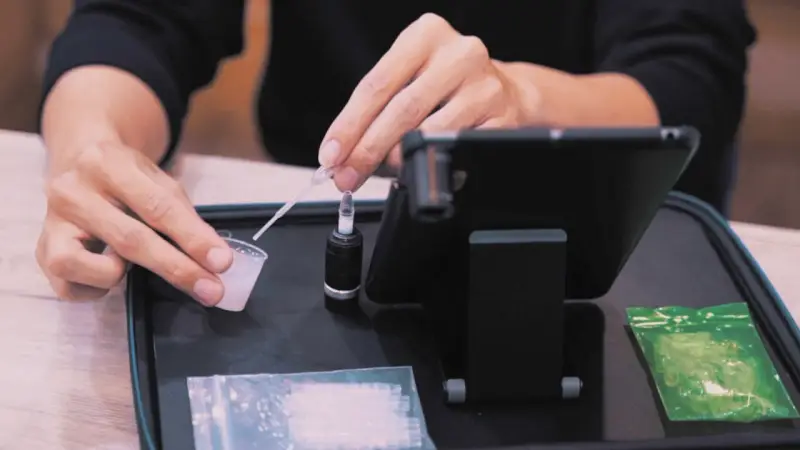
When assessing the sperm quality of a dog, there are many important factors to consider. These may include:
- Progressive motility
- Motility
- Concentration of semen
- Sperm morphology
And more.
However, it is also vital to take into account the health of the stud dog and any possible hereditary conditions that they may have. This check can be performed at a veterinary clinic.
Typically, a good dog sperm count ranges between 100 – 300 million sperm per ml of semen.
However, for this sperm to be of good quality, it must have at least 60-70% progressively motile sperm and normal morphology.
Sperm morphology refers to the quality of individual sperm cells. Those without deformities are of higher standards, and are more likely to lead to a successful pregnancy in dogs.
Lots of factors can affect the quality of sperm.
- Bacterial and viral infections
- Medications
- Diet
- Exercise
- Second-hand smoke

At Pemontell, we can give you a detailed analysis of the quality of your dog's sperm using iSperm mCASA
Cytology (Ovulation Analysis)
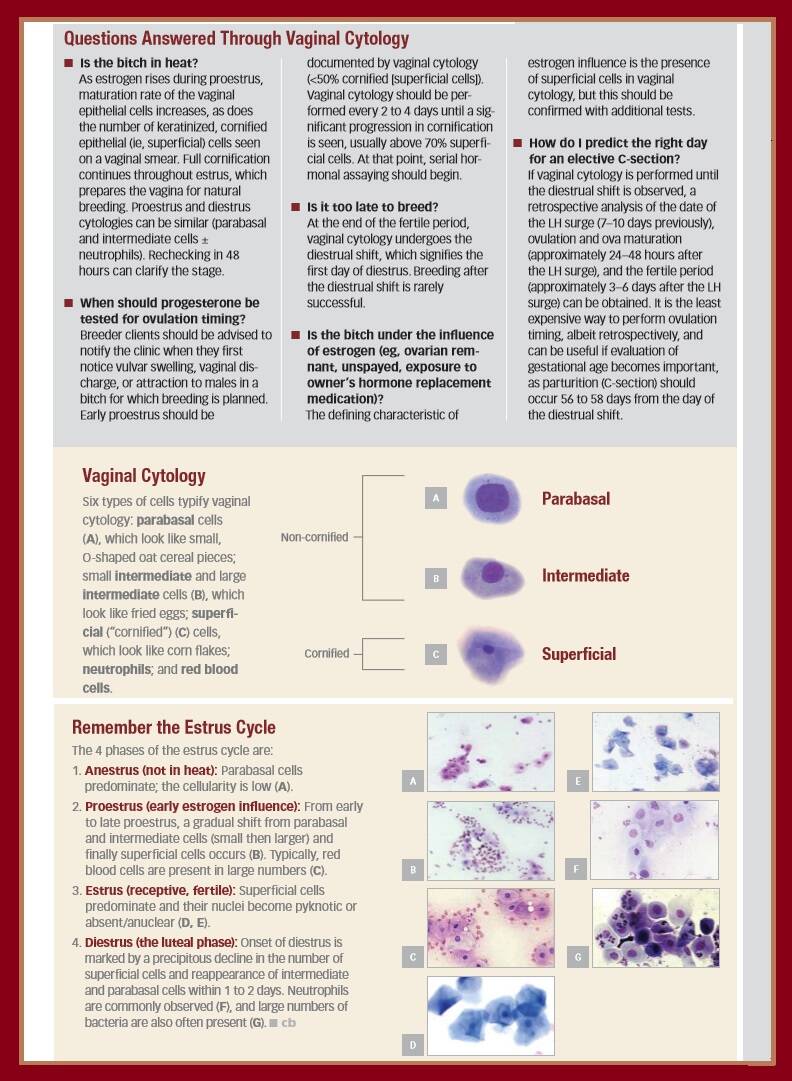
Cytology is a non-invasive procedure which involves a swab of your females vulva, cells collected are then microscopically analysed to determine your females perfect mating day. Not only does this give you a higher chance of a positive pregnancy but it also helps to improve litter size. There is no requirement to draw blood from your female for this procedure and results are provided within 15 minutes. From these results, we would recommend mating dates or a retesting date. This test is usually recommended between 7-10 of your females season. Depending on the breed, this can differ. Sometimes this will end up being a baseline test, and further tests may be required to pinpoint mating days.
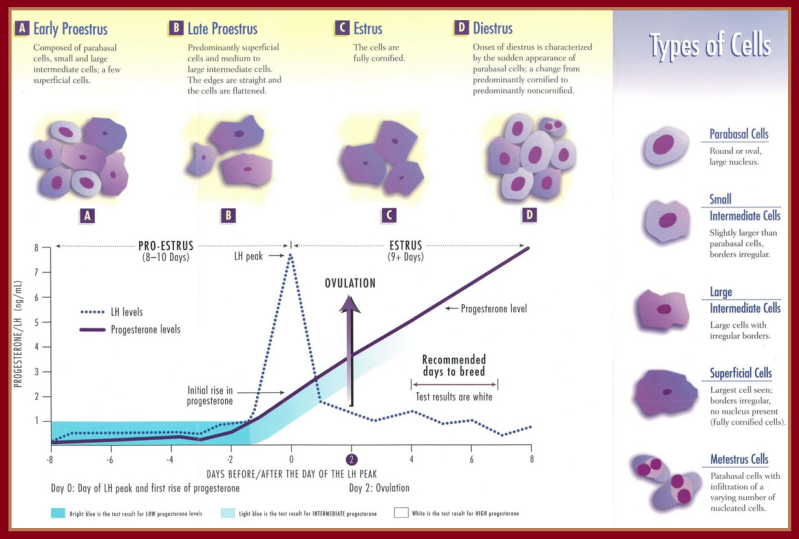
The canine estrous (reproductive) cycle is made up of 4 different stages.
These are proestrus, estrus, diestrus, and anestrus. Each stage has differing signs related to behavior, physical or clinical changes, hormonal changes, physiologic changes, and cytologic (vaginal smear) changes. The following is a general description of the various stages and the changes associated with each stage.
Proestrus is the stage that most owners start noticing changes and when we say “the dog is in heat”. This stage lasts for an average of 9 days, but can range anywhere from 0-27 days. This is when male dogs will be attracted to the female, but she will not be receptive. The estrogen levels will peak and the follicles will develop. The vulva will usually be swollen with a blood-tinged discharge. Vaginal cytology will show mixed types of cells, often with red blood cells.
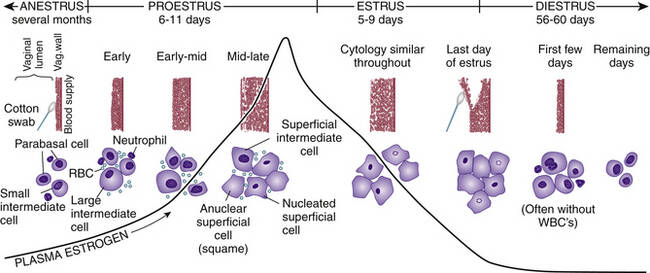
Estrus is the stage when the female is receptive to the male. This stage will last an average of 9 days based on behavioral signs, but can range from 4 to 24 days. The fertile period occurs during this time. The vulva is enlarged, but softens a little. There is a decrease in the blood in the vulvar discharge. Estrogen levels are dropping and progesterone levels are starting to increase. Vaginal cytology shows predominately cornified (flattened) epithelial cells.
Diestrus is the stage following estrus and the female is no longer receptive to the male. This stage lasts for about 2 months. Estrogen levels are low, while progesterone peaks 3 to 4 weeks after the start of diestrus and then declines to basal levels by the end of diestrus. This increase and then decrease in progesterone will occur regardless of if the dog is pregnant. Cytology shows a shift back to basal cells, with fewer red blood cells than in proestrus.
Anestrus is the time between diestrus and the next proestrus. This stage will last for about 4 months, though certain breeds can be much longer. The vulva is no longer swollen, there is no vaginal discharge. The body uses this time to allow the uterus to prepare for the next possible pregnancy. Cytology shows basal cells.
Price List
| Price | |
|---|---|
| Sperm Analysis | £45.00 |
| Cytology | £30.00 |
| Cytology Package Deal x 3 | £85.00 |
| Assistance with Matings | £70.00 |
Assistance with matings.
For breeders experiencing mating difficulties, we offer a professional Assisted Mating service to support successful pairing between a male and female dog. We strongly recommend assessing the female's ovulation and fertility status prior to any mating attempts.
Some owner's don't always have the knowledge to deal with a difficult mating and need a bit of assistance, or it may be that they are having difficulty due to:
Behavioural issues (anxiety or lack of receptivity in the female)
Physical or anatomical limitations
Size differences between the breeding pair
Our service provides gentle, guided handling to reduce stress and minimise the risk of injury. With over 30 years of breeding experience we will ensure a calm, controlled and professional process for both dogs.
Please contact us to discuss your requirements.
Terms & Conditions
Please fully read the following prior to booking and attending appointments.
Cancellation & Rescheduling:
We request 24 hours notice if you need to cancel your pet appointment. We are a small business, please respect that and understand that when you forget or cancel an appointment we miss the opportunity to fill that appointment time.
To reschedule or cancel an appointment please call us on 07340 707355 If you are cancelling your appointment outside normal working hours, please leave a voicemail providing your name, dogs name, time and date of appointment.
Non Attendance:
If you do not show for your appointment without giving adequate notice, any future bookings will require a £10 non-refundable deposit towards your next appointment. If this happens a second time we would ask for the full price of your dog’s appointment to be paid as a non-refundable payment prior to securing your booking.
Staff's Safety:
We reserve the right to muzzle your dog if it represents a danger to any person. If your dog should bite, the owner agrees to be responsible for any and all related medical bills, recovery costs, loss of income and equipment damage. Any dog that shows aggression to people will not be accepted for an appointment. Please let us know beforehand if your dog has behavioural problems.
Payments:
Payment should be made at the time of the appointment. We can accept payment by cash or card. Prices are subject to change without prior notice.
Photographs:
Your dog may be photographed before, during and after its appointment. Photographs may be used on our website, social media or other printed materials. If you do not want photos of your dog to be used on social media then please let us know at the time of your appointment.
Address
East Yorkshire
Opening Hours
By Appointment
Social media